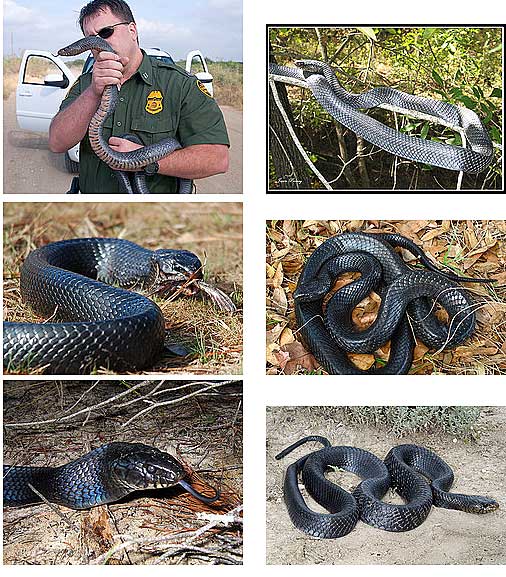
Indigo Snake
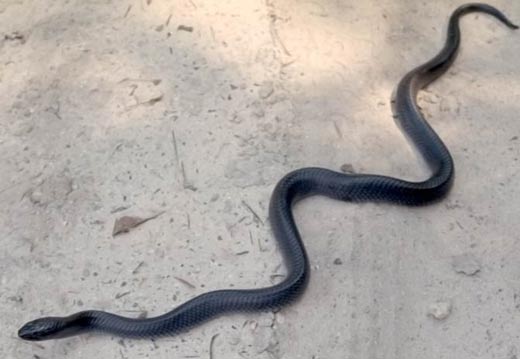
Indigo Snake
Indigo snakes feed on vertebrates, including fish, frogs, toads, lizards, snakes, birds and small mammals. They are diurnal hunters and travel long distances in a day actively searching for prey. They are non-venomous and they overpower their prey, sometimes swallowing them whole and alive.
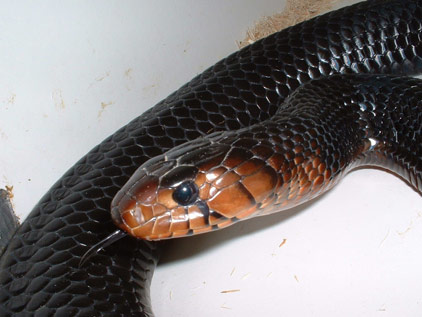
Close-up of Indigo Snake
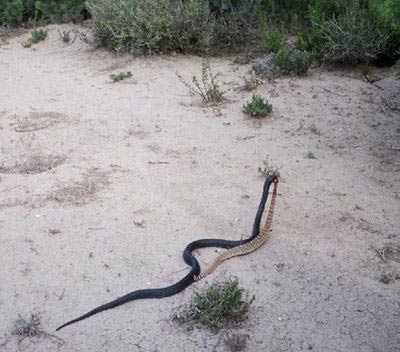
This is an indigo snake dragging-off a rattlesnake to eat. They are immune to the rattlesnakes venom. That’s nice but they probably still prefer not to be bitten if they can avoid it.
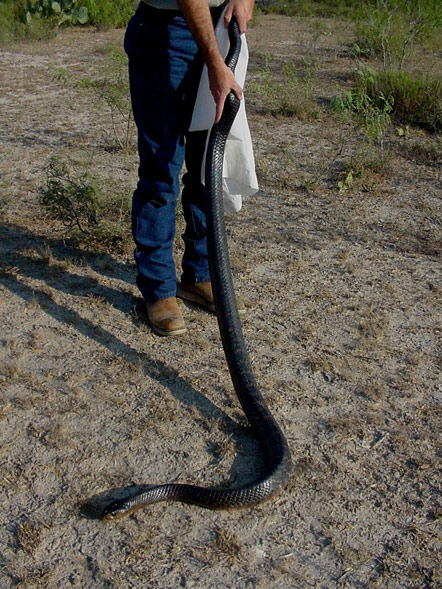
What these pictures can’t capture is how the snake has an amazing purple red (or indigo) glimmer in the sunlight. The iridescent colors in an undulating pattern are made by the lines of the scales where they meet and create an optical diffraction of the light.
Types of Indigo Snakes
There are about 7 different known related species/subspecies in the genus of the Indigo – the Drymarchon, all scattered throughout the Americas, from the southern part of the US to South America. Among those species are the Yellowtail, Orizaba, Mexican Redtail, Eastern Indigo, Unicolor, Blacktail, and Margarita Island. The all have the bright shiny iridescence but the underside, head and tails vary in color as some of their names describe. The belly can be light brown, salmon, pink or dark.
The Indigo may be the longest snake in North America with some being as long as 9.2ft (2.8m) and in Central America they may be as large as 10ft (3m).
Eastern Indigo – Endangered Species Status: Threatened
The decline of the eastern indigo snake mirrors the loss of mature long-leaf and pine forests in the South of the US. In recent decades, agricultural and residential development have deforested millions of acres. Surviving stands of forest have also been degraded by suppression of fire or by logging. Large chunks of forest have been logged and replanted with fast-growing pines that can be grown and quickly harvested. These “quick” forests do not support the eastern indigo snake.
Urbanization and agricultural development have destroyed a large percentage of this species’ habitat. Where large areas of otherwise suitable habitat remain, the suitability of those areas has often been diminished by declines in gopher tortoise population and their burrows that provide shelter for this snake. Many factors that reduce the suitability of tortoise habitat, such as fire suppression, hurt the indigo snake as well. Gassing of tortoise burrows to flesh out rattlesnakes has been shown to be lethal to other species as well. A steady loss of habitat has made this species more vulnerable to other human threats. Because it is large, conspicuous, and relatively slow, it often falls prey to people who kill snakes on sight. Snake collectors value it for the pet trade because it is nonpoisonous, docile, and attractive. Mail order specimens can bring as much as US $225. Therefore, the eastern indigo snake is in the unenviable position of being killed by some and collected by others.
Because of its large home range, the indigo snakes is especially vulnerable to highway death in areas where its habitat has been fragmented by development, including surface mining activities.