
Snake Venom
A snake bite does not necessarily mean an envenomed bite, injection of venom is under the snake’s control. Snakes will often (about 50% of the time) deliver a “dry bite” where venom is not injected. Should you be bitten, remain calm under all circumstances. Panic and shock are bigger killers than venom.
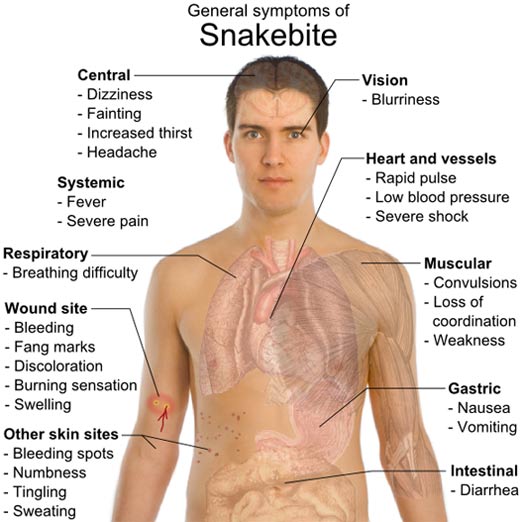
Venomous Snakes
Less than one-third of the world’s snake species are venomous and less than 10% are dangerously venomous. However, in Australia 65% of all snake species are venomous. In the United States, only 10% of the snake species are venomous.
Common Cobra venom is not on the list of top 10 venoms yet is still 40 times more toxic than cyanide.
The venom of the Australian Brown Snake is so powerful only 1/14000 of an ounce is enough to kill a human.
Types of Venom
There are a few categories of snake venom. Venomous snakes may have a mix of the following types of venom:
Haemotoxic Venom
Effects the blood and circulation. (Siamese Russell’s Viper, Malayan Pit Viper and the Green Pit viper group.)
The prey dies from cardiovasculare failure and bleeding. Human envenomation often results in great pain, swelling and bruising, drop of blood pressure, followed by bleeding from the gums, nose, eyes and in the brain. Death can result from untreated bites. Siamese Russell’s Viper and Malayan Pit Viper venom is very toxic causing severe tissue and organ damage.
Myotoxic
Effects muscle tissue. (Rattlesnakes, Sea Snakes and Sea Kraits)
In prey the venom rapidly disables muscle contractions, making it easier to hold and eat. Human bites result in pain in the legs, hips and shoulders, with paralysis and damage to the kidneys. About 25% of victims have severe muscle and kidney damage. Venom can cause muscle necrosis (the death of cells and tissue).
Neurotoxic
Effects the nervous system. (King Cobra, Siamese and Spitting Cobras, the Krait family)
There is a progressive paralysis of the skeletal and peripheral muscles, followed by death from respiratory failure. Human envenomation starts with drooping eyelids and a dazed sleeplike paralysis, sometimes followed by spasms, excess salivation and vomiting. Swelling and tissue damage can also occur. Without treatment death can result from respiratory failure. Siamese Cobra venom is more toxic than King Cobra venom, but the King Cobra injects a much larger volumne of venom with its bite. Malayan krait venom is the most toxic of the kraits and the snake usually bites at night while the victim is sleeping and the sleeplike symptoms of paralysis can go unnoticed.
Cytotoxic
Destroys cells. (Puff Adder)
In humans, bites from this species can produce severe local and systemic symptoms, bleeding, swelling and pain. Puff Adders are responsible for more fatalities than any other African snake.
Dealing with snakes
Humans kill many more snakes than snakes kill humans. Leave the snake alone and it will leave you alone. Most bites occur when people attempt to kill snakes. You are statistically more likely to be struck by lightning or kicked to death by a donkey than to die of a snakebite. More people die of human bites in South Africa than of snake bites.
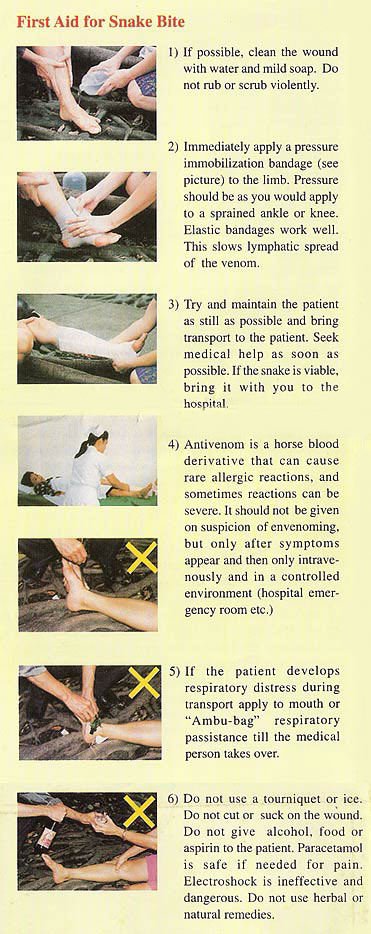
First Aid
First Aid instructions as printed in the visitor’s brochure at the Queen Saovabha Memorial Istitute and Snake Farm in Bangkok, Thailand.
More about the
Queen Saovabha Memorial Institute and Snake Farm